Rethinking New Womanhood by Nazia Hussein
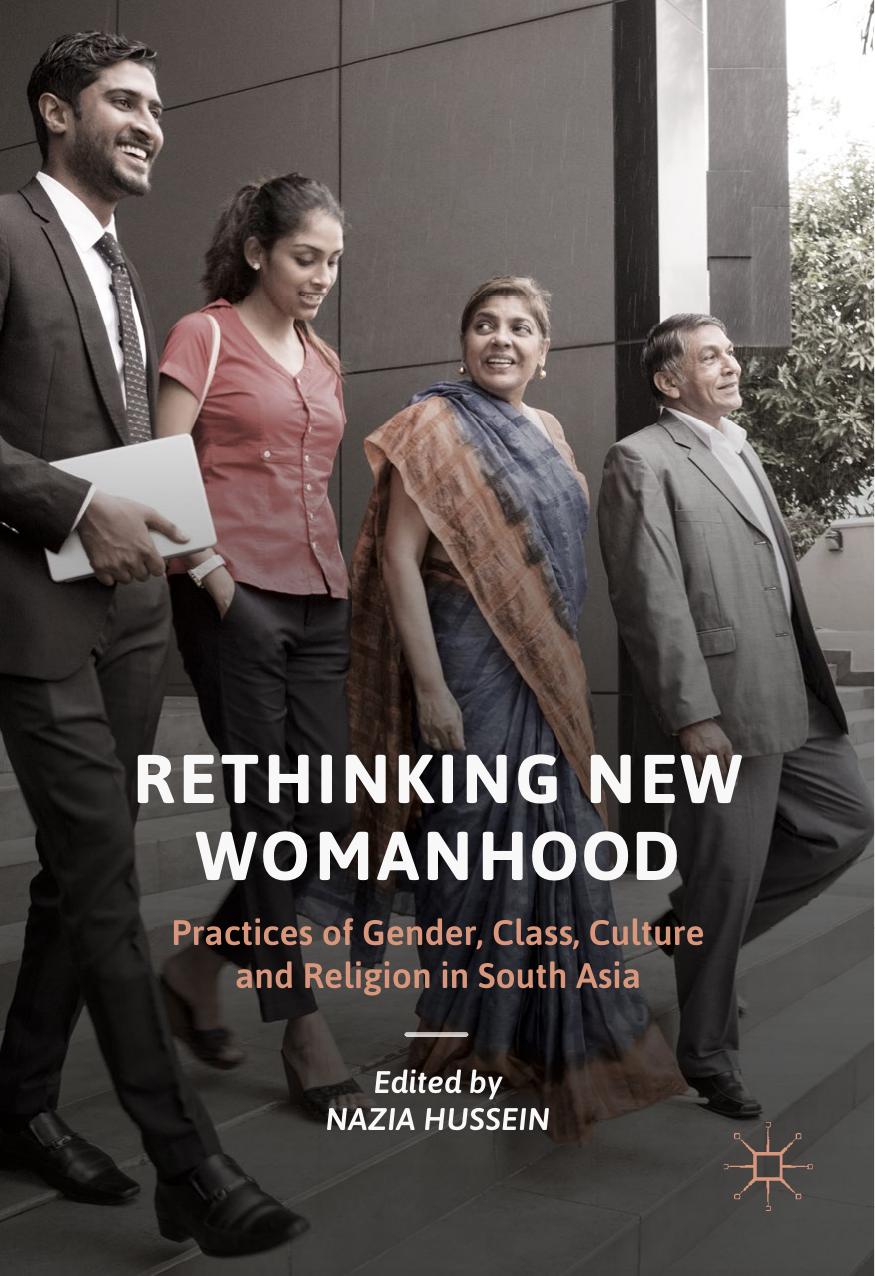
Author:Nazia Hussein
Language: eng
Format: epub, pdf
Publisher: Springer International Publishing, Cham
Shanta highlights the importance of mixing the boldness of modern women with Bengali cultural attire like a sari and how this combination gives her more authority and respect among the Bangladeshi male government officials she has to interact with. Mount (2017) showed that in India the cultural attire of sari accord women respect and authority and symbolise them as a ‘mother figure’ who must be respected by all. Here, although Shanta’s personal taste of Western fashion is contrary to both her organisation’s clients’ expectations and middle-class respectability norms in Bangladesh, she uses her knowledge of what clothes are appropriate for each context to maintain her partnership with various organisations. Thus, it cannot be said that there is a single cultural flow from the West to the East which dominates hybrid fashion cultures in Bangladesh. Hybrid fashions of post-colonial societies are influenced by a variety of aspects, and women today have developed a heightened sense of self-consciousness and embody their own version of modernity. Aesthetic labour is an embodied aspect of ‘professionalism’, a form of cultural capital that can be converted to other forms of capital—such as economic capital as income or symbolic capital of global professional womanhood—to reproduce social class by employees. An organisation’s brand is aimed at particular social groups and seeks to appeal to their senses; it is capable of adding cultural and symbolic value to the target customer and the employees, creating ‘lifestyles’ that mark differences of class and status (Pettinger 2004, p. 171). I argue that new women participants’ workplaces play an important role in their self-construction of new womanhood through alternative practices of respectable clothing, to the degree that women are able to evaluate the costs and benefits involved in converting their cultural capital of smart dressing into the economic capital of income or the symbolic capital of global professionalism in various organisations they work for.
Finally, dresses and skirts exposing lower legs and long gowns, which are often sleeveless or halter necked and expose shoulders and cleavage, are occasionally worn by younger participants who lived in Western countries for many years as party wear. Again, these are not suitable for family occasions, weddings, or cultural and religious festivals. Rather, these are only worn for parties with friends of the same age group in five-star hotels or someone’s house, outside the purview of the rest of the society.
Gilbertson (2011, p. 170) argues middle-class ‘cultural capital, then, is not just about being able to afford fashionable clothes, but also about knowing what kinds of clothes are appropriate to each occasion or field’. I identify participants’ knowledge and boundary work of adapting to organisational aesthetic norms, Bengali middle-class respectable aesthetic norms, and their personal choices of wearing Western clothes in Western countries and Western party wear within Bangladesh among their peers of the same social class as the cultural capital of smart dressing. This knowledge and boundary work provides them cultural authorisation for alternative forms of respectable femininity and new womanhood. Participants also convert their cultural capital to
Download
This site does not store any files on its server. We only index and link to content provided by other sites. Please contact the content providers to delete copyright contents if any and email us, we'll remove relevant links or contents immediately.
| Anthropology | Archaeology |
| Philosophy | Politics & Government |
| Social Sciences | Sociology |
| Women's Studies |
Cecilia; Or, Memoirs of an Heiress — Volume 1 by Fanny Burney(32558)
The Great Music City by Andrea Baker(32018)
Cecilia; Or, Memoirs of an Heiress — Volume 2 by Fanny Burney(31956)
Cecilia; Or, Memoirs of an Heiress — Volume 3 by Fanny Burney(31941)
We're Going to Need More Wine by Gabrielle Union(19046)
All the Missing Girls by Megan Miranda(16023)
Pimp by Iceberg Slim(14506)
For the Love of Europe by Rick Steves(14121)
Bombshells: Glamour Girls of a Lifetime by Sullivan Steve(14073)
Talking to Strangers by Malcolm Gladwell(13370)
Norse Mythology by Gaiman Neil(13363)
Fifty Shades Freed by E L James(13239)
Mindhunter: Inside the FBI's Elite Serial Crime Unit by John E. Douglas & Mark Olshaker(9339)
Crazy Rich Asians by Kevin Kwan(9290)
The Lost Art of Listening by Michael P. Nichols(7506)
Enlightenment Now: The Case for Reason, Science, Humanism, and Progress by Steven Pinker(7311)
The Four Agreements by Don Miguel Ruiz(6763)
Bad Blood by John Carreyrou(6621)
Weapons of Math Destruction by Cathy O'Neil(6279)
